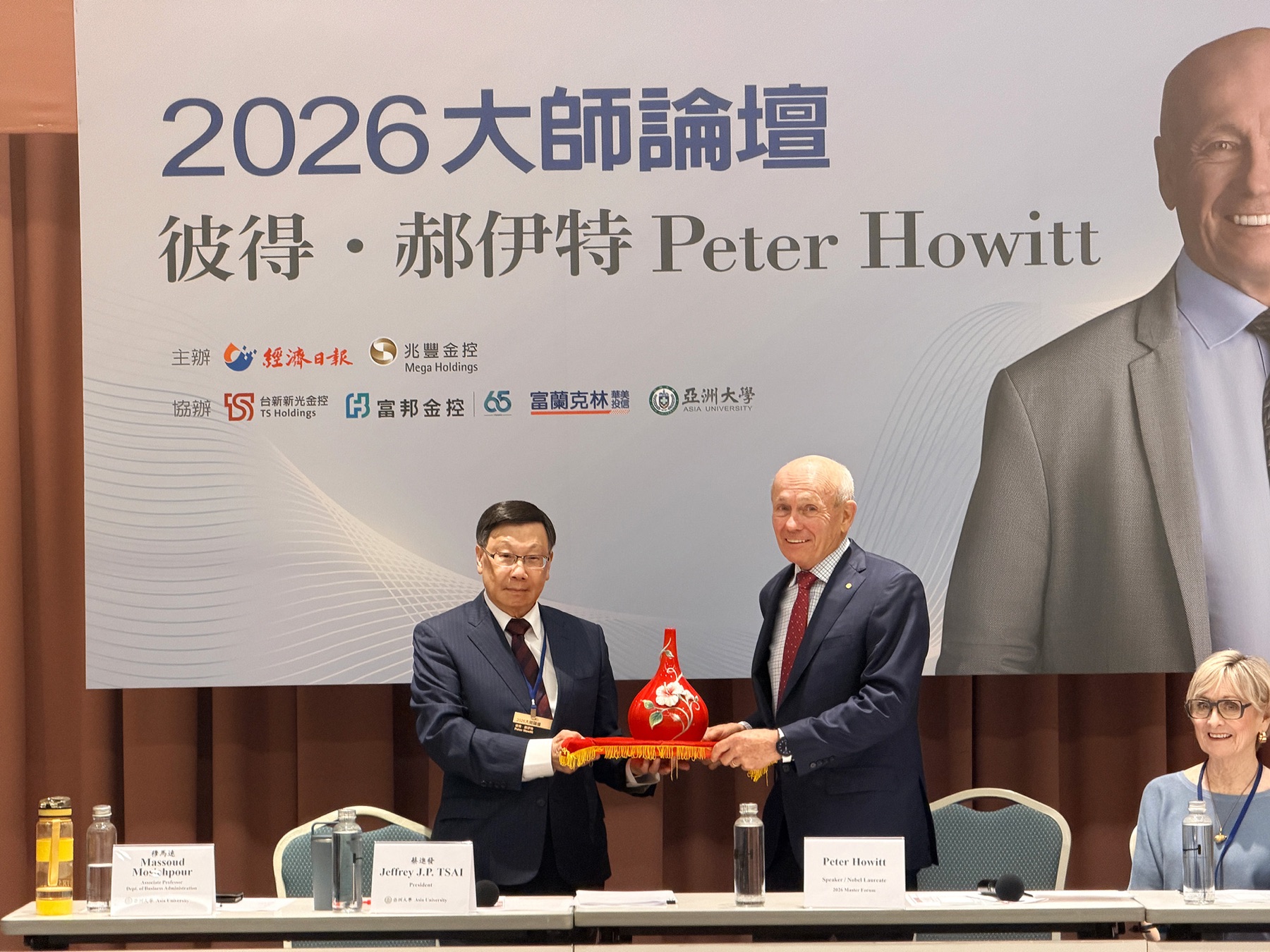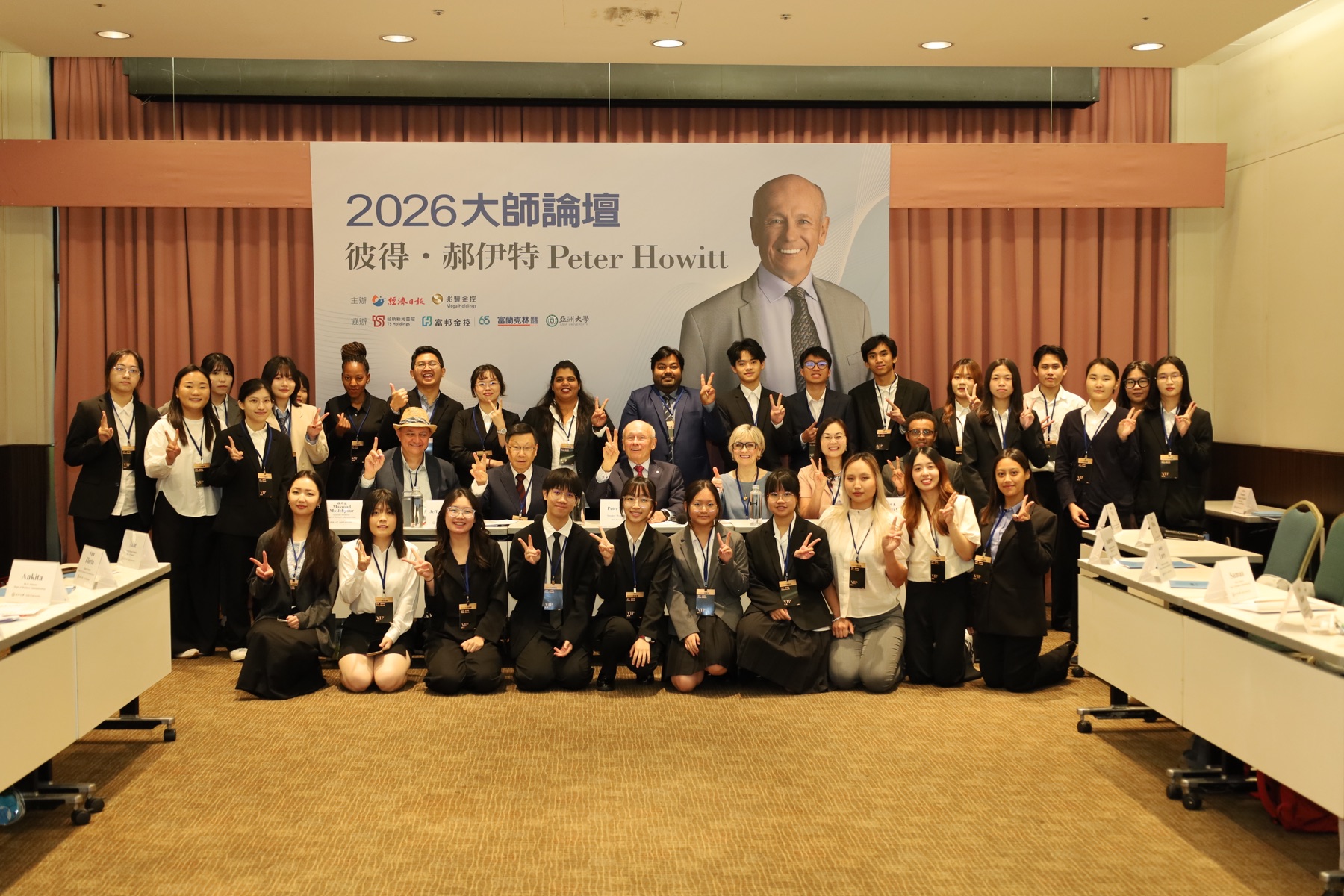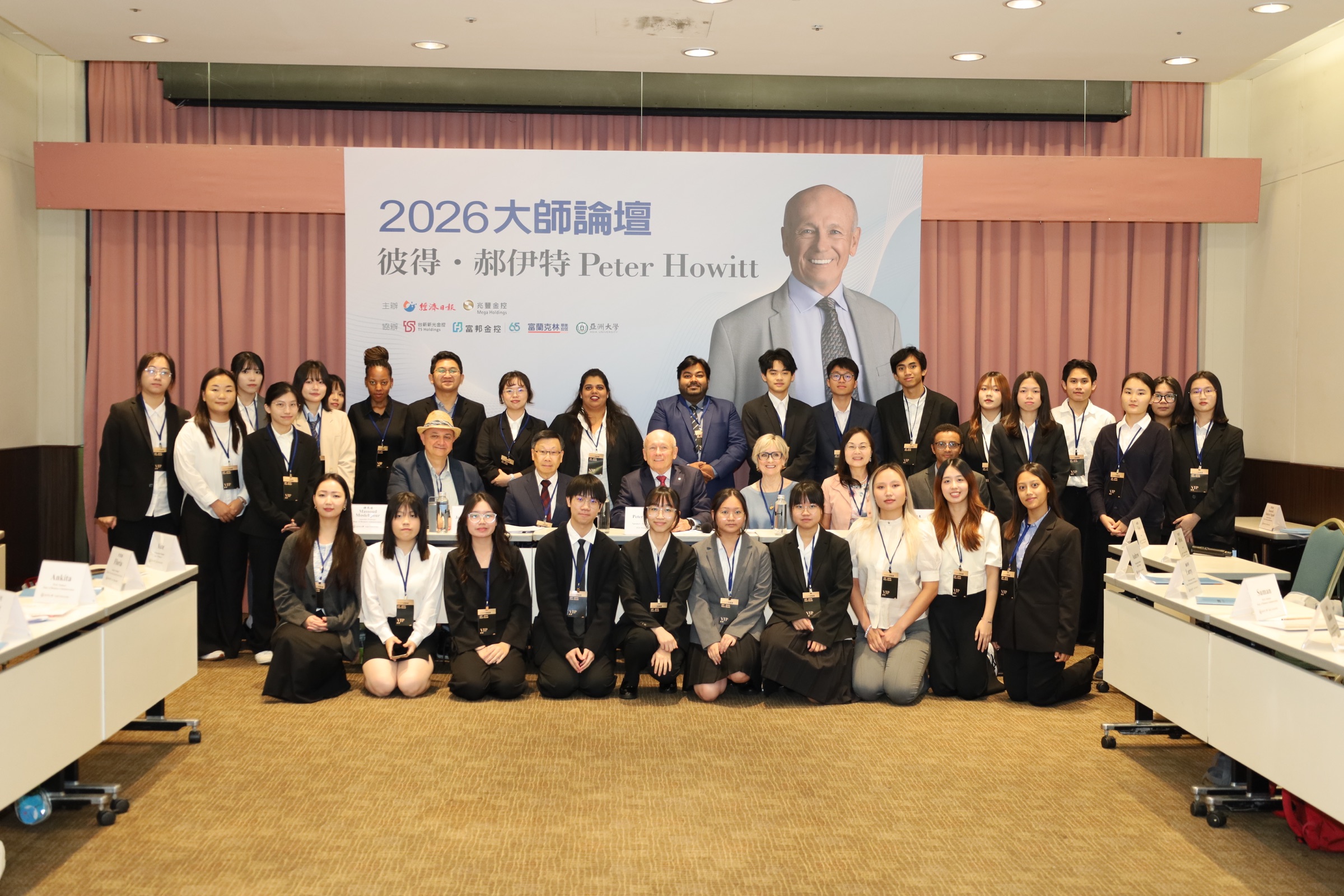
On May 12, 2026, Asia University joined the 2026 Master Forum at the Taipei International Convention Center, where Professor Peter Howitt—2025 Nobel Laureate in Economic Sciences and one of the leading scholars of modern growth theory—met faculty and students for an all-English academic exchange.
Asia University President Jeffrey J. P. Tsai led a diverse delegation that included local and international students from Taiwan, India, Indonesia, Vietnam, Mongolia, Eswatini, and other countries, together with students from strategic-alliance high schools. Dean Ming-Huei Chen and Asia University faculty, master’s students, and doctoral students also participated.
01
Creative Destruction in the Age of AI
Professor Howitt’s keynote address, “Creative Destruction and Economic Growth,” examined how technological innovation drives long-term economic growth while replacing older technologies, business models, and industries. This process—creative destruction—has become especially relevant as AI reshapes work, education, competition, and the global distribution of opportunity.
Rather than presenting AI only as a threat, the forum considered its capacity to generate new professions, expand human capabilities, improve public welfare, and open new paths for innovation. At the same time, the discussion recognized serious concerns about regulation, inequality, market concentration, and the disappearance or redesign of entry-level work.
02
A Global, Cross-Generational Student Dialogue
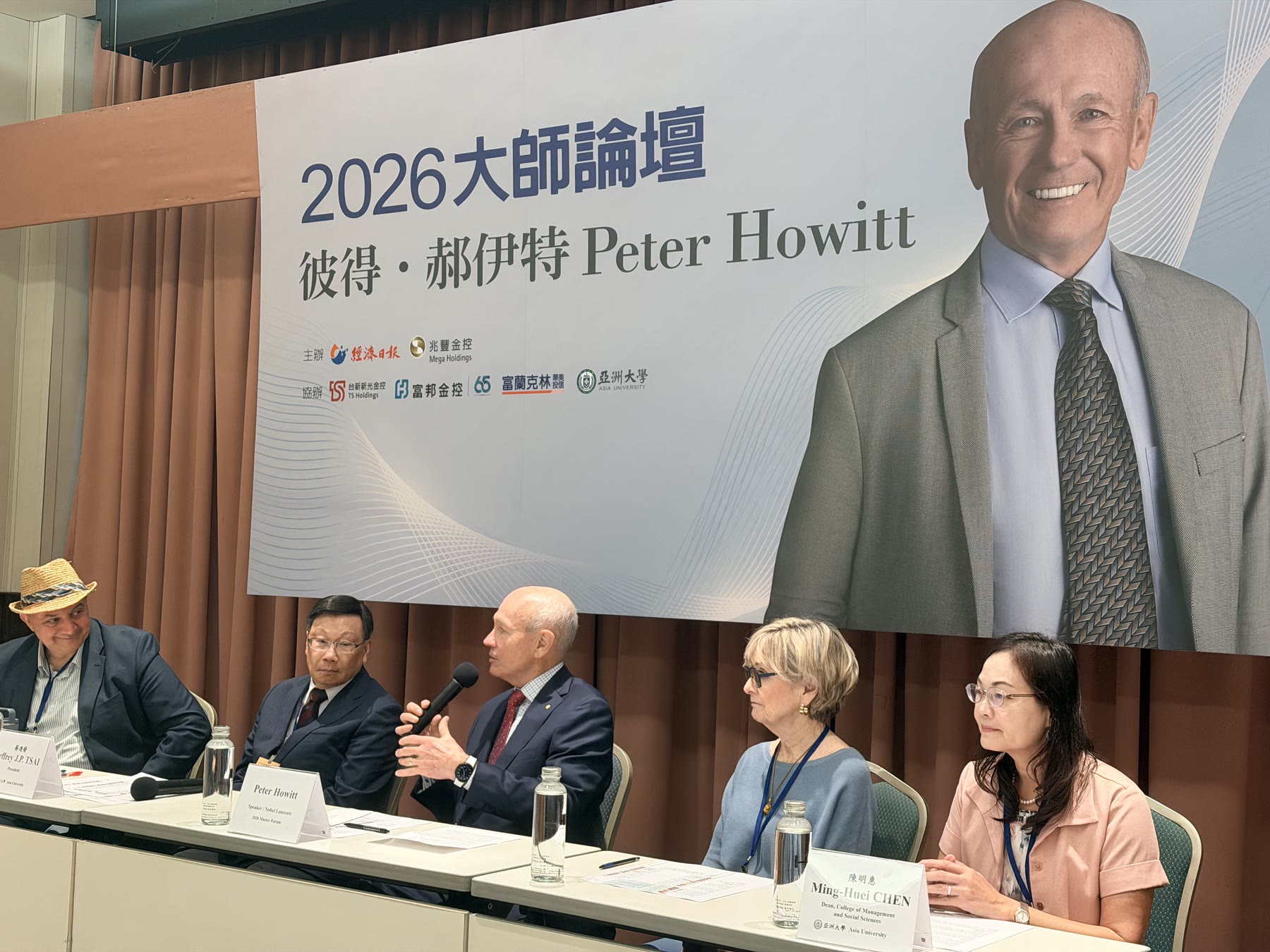
Following the keynote, Asia University faculty and students took part in an approximately one-hour discussion with Professor Howitt. Their questions connected economic theory with practical challenges facing governments, universities, businesses, and young people.
AI governance
How can public policy protect society without slowing innovation when AI develops faster than legal and regulatory systems?
Education and employment
How should universities help students acquire practical knowledge, judgment, and human capabilities that AI cannot easily replace?
Semiconductors and development
Can developing countries participate fairly when advanced technologies require large investments, specialized talent, and global alliances?
Entrepreneurship and competition
How can antitrust policy prevent dominant companies from using acquisitions, patents, or AI resources to suppress new competitors?
Finance and innovation
Which financing decisions can AI support, and where will human judgment, trust, and understanding of technology remain essential?
Social fairness
How can societies distribute the benefits of technological progress more broadly while responding to inequality and job displacement?
03
A Message for Students Entering an Uncertain Future
When Dean Ming-Huei Chen asked Professor Howitt what advice he would offer young people preparing to enter the workforce, he emphasized that uncertainty also creates possibility. He encouraged students not to choose a career merely because it appears safe, but to identify work that genuinely matters to them and pursue it with commitment.
“Find something you are truly passionate about and commit to it fully.”
Professor Peter Howitt, 2025 Nobel Laureate in Economic Sciences
His message was optimistic but demanding: the AI era will reward curiosity, judgment, creativity, adaptability, and the willingness to keep learning. New technologies may disrupt familiar career paths, but they will also create opportunities that cannot yet be fully imagined.
04
International Learning Beyond the Classroom
The forum demonstrated the value of bringing students into direct conversation with world-leading scholars. Participants were not passive audience members; they tested ideas, raised policy concerns, and connected Professor Howitt’s research with the realities of their countries, fields of study, and future careers.
The range of nationalities and academic levels—from high school students to doctoral researchers—also reflected Asia University’s commitment to internationalization and English-medium academic engagement. The event created a shared space in which economics, technology, law, education, finance, and management could be discussed together.
Personal reflection
Preparing Students to Enter Serious Academic Dialogue
I was pleased to participate in the forum and to see Asia University students engage Professor Howitt with questions that connected economic theory to policy, management, finance, education, and social responsibility. The discussion showed that students do not need to be passive recipients of major ideas; with careful preparation, they can enter serious dialogue with the scholars who shaped those ideas.
For management education, Professor Howitt’s message is especially relevant. The safest response to technological change is not to avoid disruption, but to build the knowledge, judgment, adaptability, and ethical awareness needed to contribute within it. That is a demanding message for educators and students—but also an encouraging one.